
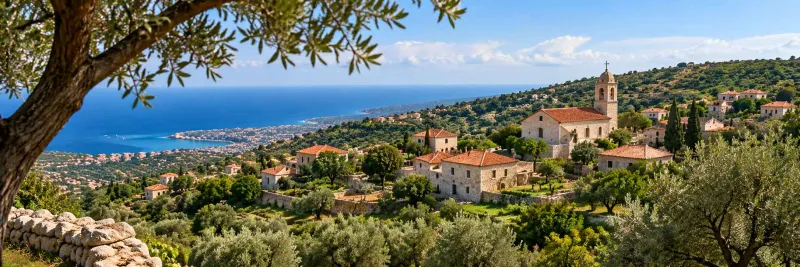
About Jeddayel
A town in the Jbeil district, between the sea and the hills.
Jeddayel: A Village of Heritage, Nature, and Community in the Hills of Byblos
From the churches of Saint Doumit to olive groves, carob trees, and the Mediterranean horizon, discover a Lebanese village where history, traditions, and community life remain closely connected.
A village between the hills and the Mediterranean
Nestled in the Byblos District of Lebanon's Keserwan-Jbeil Governorate, Jeddayel is a picturesque village overlooking the Mediterranean Sea. Its setting combines the natural beauty of Lebanon's coastal hills with the traditions of rural life.
Located north of the historic city of Byblos, Jeddayel stands approximately 200–220 metres above sea level. Published electoral and geographic records place it around 45 kilometres from Beirut and approximately 7 kilometres from the administrative centre of Byblos by road.
Its landscape is characterized by rolling hills, residential neighbourhoods, cultivated land, and Mediterranean vegetation. The village enjoys proximity to the coast while retaining the atmosphere of a traditional Lebanese rural community.
Geography, area, and population
Jeddayel is known by several Latin spellings, including Jeddayel, Jdayel, and Geddayel.
Published estimates of its area differ, ranging from approximately 1.05 to 2 square kilometres. A Lebanese village encyclopedia records 120 hectares, equivalent to 1.2 square kilometres. These differences require clarification through official cadastral records.
Population estimates also vary. Some references suggest approximately 1,000 residents, while others report around 1,500 inhabitants. Neither figure should be treated as a verified current census.
Electoral records published for 2014 identify 568 registered voters, including 298 women and 270 men. Registered voters are not equivalent to the resident population, particularly in communities with family members living elsewhere in Lebanon or abroad.
The origins of the name Jeddayel
The village's name reflects the complex linguistic heritage of the Lebanese mountains.
Historical researchers have proposed several possible origins. Some associate the name with ancient Semitic or Syriac expressions referring to fortune, destiny, or divine providence. Another interpretation connects it to the Arabic word for braids.
These explanations remain scholarly hypotheses rather than established historical conclusions.
Local accounts recorded in a Lebanese village encyclopedia also mention ancient stonework and burial structures reportedly discovered in the surrounding area. Such accounts offer potential avenues for archaeological investigation, although they do not establish a precise date for the village's earliest settlement.
Qornet Al Roum and the surrounding villages
Jeddayel forms part of the wider area traditionally known as Qornet Al Roum.
This geographical and social environment includes communities such as Mounsef, Barbara, Chikhane, Rihani, Gharzouz, Bekhaz and Hosrayel. Historical references differ slightly in how they define the complete group.
The surrounding villages share longstanding social, religious, and family connections. Their proximity has encouraged cooperation, community gatherings, and economic exchange.
Jeddayel also benefits from its location near Byblos, one of Lebanon's best-known historic cities, and the wider coastal communities of the district.
Religious heritage and the churches of Jeddayel
Religious heritage is central to the village's identity.
Jeddayel is known for three churches: the Maronite Church of Saint Doumit, the Greek Orthodox Church of Saint Doumit, and the Church of Our Lady.
The dedication of two churches to Saint Doumit reflects the saint's importance in local religious tradition and illustrates the presence of both Maronite and Greek Orthodox communities.
Beyond their religious functions, the churches have historically served as places for social gatherings, family celebrations, and community events.
The feast of Saint Doumit is among the village's best-known traditional celebrations, with published accounts describing communal dinners and festive gatherings.
Agriculture: Olives, Carob, and rural traditions
Agriculture has long contributed to Jeddayel's identity.
Historical references describe the cultivation of olives, carob, figs, almonds, and grapes, alongside other seasonal crops.
Olive cultivation is especially significant within the wider Mediterranean heritage of Lebanon. Traditional harvesting and oil pressing have connected generations of families to the land.
Carob trees are another distinctive feature of the local landscape. Their fruit has traditionally been used to produce carob molasses and other food products.
Published descriptions of Jeddayel refer to olive presses and carob-processing facilities, reflecting the historical importance of these agricultural activities.
Preserving this heritage offers opportunities for environmental protection, cultural documentation, and renewed interest in local agricultural products.
Climate and weather throughout the year
Jeddayel has a Mediterranean climate, characterized by warm, relatively dry summers and cooler, wetter winters.
Its proximity to the sea moderates seasonal temperatures, while the surrounding hills and Wadi Jeddayel influence local air circulation.
Historical climate observations for nearby Byblos provide a useful regional reference, although they are not measurements from a dedicated weather station in Jeddayel.
|
Season |
Typical conditions |
|
Winter — December to February |
Cool, humid, and rainy |
|
Spring — March to May |
Mild temperatures, greenery, and decreasing rainfall |
|
Summer — June to August |
Warm to hot, humid, and generally dry |
|
Autumn — September to November |
Warm early in the season, followed by cooler temperatures and returning rainfall |
For nearby Byblos, the 1991–2020 climate reference indicates an annual mean temperature of approximately 20.2°C and annual precipitation of around 942 mm. January averages about 13.2°C, while August averages approximately 26.7°C.
These are long-term climatic averages, not live weather forecasts.
Community celebrations and village life
Jeddayel's social identity is closely linked to its religious feasts, seasonal celebrations, and family gatherings.
Published descriptions mention the annual Saint Doumit festivities, end-of-summer celebrations, Christmas decorations, and theatrical performances for children and families.
Such occasions provide opportunities for residents, returning emigrants, and visitors to reconnect with the village.
Sports, youth activities, and cultural initiatives also have an important role to play in sustaining a vibrant community and encouraging participation across generations.
Municipality and local development
Jeddayel's modern municipal history began in 2016, when the village held its first municipal elections.
Published historical accounts identify Dr. Boutros Boulos as its first mayor.
Municipal administration provides a framework for addressing local concerns, including infrastructure, roads, public lighting, environmental protection, and community services.
Future development presents an opportunity to balance improved facilities with the protection of agricultural land, village character, and natural surroundings.
The diaspora: Keeping Jeddayel connected
Like many Lebanese villages, Jeddayel's identity extends beyond its geographical boundaries.
Family connections, summer visits, celebrations, and shared memories maintain relationships between the village and people of Jeddayel origin living elsewhere.
A dedicated community newspaper can strengthen these connections by documenting local news, preserving photographs and historical accounts, highlighting achievements, and providing a platform for residents and the diaspora.
A heritage worth preserving, a future worth building
Jeddayel's importance lies not only in its geographical location but also in its collective memory, traditions, religious landmarks, agricultural heritage, and community relationships.
As the village continues to develop, preserving its natural environment and cultural identity will remain essential.
Jeddayel is more than a village on the map of Byblos. It is a living story of land, heritage, family, and belonging — a community carrying its traditions proudly into the future.